
Physics Engineering
Résumé
The Polytech Clermont Physical Engineering program is a scientific and technical course covering a broad multidisciplinary range of skills in physics for the implementation of materials. Read moreAccéder aux sections de la fiche
Call to actions
Details
Introduction

The Physics Engineering program at Polytech Clermont is a scientific and technical training that covers a very broad range of multidisciplinary skills in the field of physics for the application of materials and energy.
The aim is to train engineers capable of successfully managing projects, handling them as components of large and complex systems, in industrial environments (Research & Development, design offices, production) or in research laboratories.
Objectives
The project-based teaching is an essential component that allows future engineers to apply their skills and experience the management of a real industrial project in all its aspects: technical, budgetary, scheduling, organization, teamwork, subcontracting… etc.
Open-mindedness, listening and synthesis skills, as well as the ability to present work clearly, are also developed through communication and management courses.
Environmental standards, total quality management and sustainability, and safety issues related to industrial production are addressed within the curriculum with significant involvement from industry professionals.
Specificities
Courses in the field of ENGINEERING SCIENCES
? Material characterization and shaping? High-value materials (metallurgy, electronics option)
? Non-destructive testing
? Quality
? Nuclear energy
? Energy engineering
? Modeling and simulation
? Project management
Advanced courses in PHYSICS and PHYSICAL CHEMISTRY
? Statistical and quantum physics? Solid-state physics: electrical and magnetic properties, Metallurgy
? Crystallography
? Fluid mechanics and thermodynamics
? Electromagnetism and wave optics
? Spectroscopy
? Physical chemistry of materials and solutions
Person in charge of the academic program
Tél : +33473407500
Email : yamina.andre@uca.fr
Partnership
In agreement with


Admission
-
Prerequisites training
The Physical Engineering program recruits students for the engineering cycle from:
- Students from preparatory classes (CPGE): MP, PC, PSI, PT, ATS, TSI
- Students from the Polytech PeiP preparatory cycle
- University students (L2, L3)
- Students from BUT programs with a profile suited to the training
- Other applicants with a 2- or 3-year degree whose background aligns with the program requirements
-
Conditions of applications
Program
Les informations ci-dessous sont données à titre indicatif et peuvent faire l'objet de mises à jour.

From the 4th year onward, several options are available:
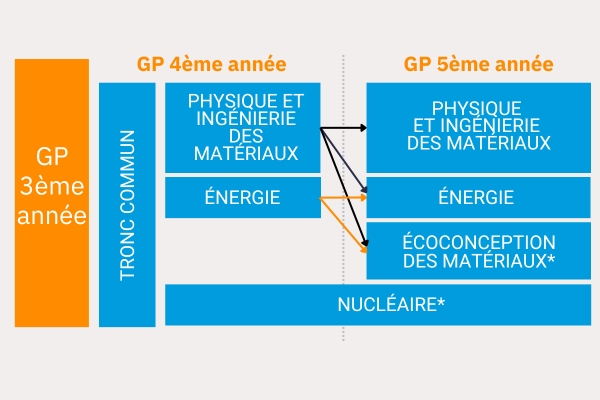
- Materials Physics and Engineering Track
-
The Materials Physics and Engineering option is specific for final-year students of the Polytech engineering cycle.
Objectives:
- Characterization, final push … Spectroscopy – Optics – Optronics – Optoelectronics.
- Shaping of metallic materials
- Nano physics and multi-scale approach
- Introduction to composite and ceramic materials.
Targeted Skills:
- The Physical Engineering graduate is able to quickly adapt to the complexity of a constantly evolving global industry in order to develop or optimize innovative products or processes based on the transformation of matter and energy.
- Application of physics knowledge to future technologies: Design, Innovation, Implementation, Optimization
- Development and characterization of multi-scale materials (nano to macro).
Main Focus Areas:
- Engineering Sciences
- Non-Destructive Testing
- Selection and implementation of metallic materials
- Matter-radiation interaction
- Surface Physics
- Physical Chemistry
- Expression / Communication
- English
Opportunities:
- Professionalization contract option: Alternating study/work program.
- Double-degree possibility with UCA Master's programs:
- Fundamental Physics and Applications (Nano Physics and Universe & Particles track)
- Physics and Radiation Technologies for Industry and Medical Physics (PTR-IPM)
- Energy Track
-
The Energy track, launched in September 2024, is available to Physical Engineering students from the 4th year. It allows students to acquire a specialization (about 120 hours of dedicated training) in the energy sector, particularly in high-demand fields.
This track allows continuation into the final year of the engineering cycle with the transversal Energy option (providing complementary skills in building thermal management, renewable energies, and the nuclear sector) or with another transversal option.
Covered Areas:
- Nuclear engineering: knowledge of the nuclear sector from fuel to waste
- Thermal, fluid mechanics, thermohydraulics (steam generation and numerical simulation tools)
- Use and management (thermal, electrical…) of batteries
- Decarbonization and integration of hydrogen into the economy (production, storage, safety, use)
- Nuclear Track
-
The creation of a Nuclear track within the Physical Engineering department in the 4th and 5th years in September 2025 is based on the PTR-IPM Nuclear Engineering Master of the UCA Institute of Sciences (EUPI), in order to meet the challenges of the nuclear revival in France.
The goal is to combine materials physics training for Physical Engineering students with nuclear engineering from the IN-PTR-IPM Master's program at UCA. This dual competence will benefit from advanced and comprehensive specialization in NDT (non-destructive testing), as well as a global vision of ionizing radiation physics and technologies used in the Master's program, creating a high-level and unique engineering track in France. The demand for specialists will be high for the construction, maintenance, and dismantling of nuclear plants (Match program, April 2023).
Main Upcoming Challenges:
- Management of new nuclear reactor construction (EPR, SMR)
- Engineering of existing fleets (major overhaul program > 60 years)
- CIGEO (deep radioactive waste storage)
- Dismantling of end-of-life reactors
Employment:
- 3rd largest industrial sector in France with 220,000 jobs
- Expected: 100,000 hires by 2033
- In 2023, EDF hired 40% of Master's graduates for 8,800 positions (fixed-term and permanent contracts, excluding FISA)
Main Players: EDF, Framatome, Orano, TecnicAtome, GIFEN, DGA
Covered Areas:
- Reactor physics
- Modeling / Simulation
- Radioprotection / Safety
- Materials physics
- Non-Destructive Testing
- Waste management / Dismantling
Targeted Professions:
- Operations Engineer
- Neutronics Engineer
- Reactor Operator
- Safety/Criticality Calculation Engineer
- Radioprotection Calculation Engineer
- Research and Development Engineer
- Physical and Nuclear Measurement Engineer
- Waste / Dismantling Engineer
Track co-delivered with the PTR-IPM Nuclear Engineering Master: link
- Materials Eco-Design Option
-
The Materials Eco-Design track is available in the final year of the engineering cycle. It allows students to complete their training with a specialization in bio-based materials and sustainable development, in line with ecological transition and green economy challenges.
This specialization trains engineers capable of designing, characterizing, and optimizing materials with lower environmental impact while integrating technical, industrial, and economic constraints.
Covered Areas:
- Bio-based materials, biopolymers, and agro-composites
- Eco-design and life cycle analysis
- Material selection and optimization with a sustainability perspective
- Integration of environmental and economic concerns in industrial projects
- Energy Option
-
The Energy track is available in the final year of the engineering cycle. It allows students to acquire specialization in professions related to the production, distribution, storage, and use of energy while maintaining the specificity of the home department.
This specialization prepares students for current challenges in energy transition, decarbonization, and optimization of energy systems.
Covered Areas:
- Scientific and economic fundamentals of energy
- Renewable energies (wind, solar, hydro, bioenergy)
- Nuclear and fossil energies
- Energy storage, transport, and distribution
- Energy consumption management and optimization (building and industry)
Professionalization Contract
Professionalization contracts are offered to final-year engineering students.
Students in initial training change status and become employees of the host company. The duration of the professionalization contract is 12 months.
A win-win approach
- For the student: the aim of the professionalization contract is to acquire professional qualifications while validating the engineering diploma. Beneficiaries are remunerated as a percentage of the minimum wage according to age and level of education. For details on remuneration, refer to the Ministry's website.
- For the company: this contract allows access to a quickly operational engineer trained in its methods. The professionalization contract may also give entitlement, under certain conditions, to exemptions from employer social security contributions.
Eligibility
The professionalization contract is open to:
- Students in initial training at Polytech Clermont aged 16 to 25 and admitted to the final year of the engineering cycle,
- All employers subject to financing continuing professional training, except the State, local authorities, and their administrative public institutions.
Students with disabilities wishing to sign a professionalization contract are supported. Check the measures HERE.
Assessment Methods
- This track includes 2 intermediate presentations, a report, and a final presentation.
- These are supplemented by all assessments implemented by teachers as part of continuous assessment.
- It is not possible to validate one or more competency blocks independently.
Funding
Training costs, covered by the company, include the pedagogical registration and the cost of training at Polytech Clermont. Part or all of the training cost may be covered by the Competency Operator (OPCO) to which the company belongs.
-
- Elément Année GP3A
-
Semestre 5
-
-
-
Mathématiques
-
Statistiques et probabilités
-
-
-
Electronique
-
Mécanique des Fluides
-
-
-
Physique Quantique
-
Outils Mathématiques
-
Soutien Physique
-
-
-
-
-
Electronique
-
Traitement du signal
-
Mécanique
-
Biologie
-
Matière matériaux
-
Energétique
-
Initiation dessin technique
-
Autour du web
-
Maths 1 GC/GE/GP/Archi
-
Maths 2 GC/GE/Archi
-
Maths GB
-
Méthodes statistiques
-
-
Socle informatique
-
Projet 1
-
-
-
-
E2C1
-
Anglais 1
-
-
-
Droit
-
Economie
-
-
-
-
-
Thermique
-
Optique
-
RDM
-
Electromagnétisme
-
-
-
Physique Statistiques
-
Physique du Solide
-
Cristallographie
-
-
Mathématiques 2
-
-
-
-
Analyse numérique
-
Bases de données
-
-
Projet 2
-
-
Métallurgie
-
Physicochimie
-
Polymères
-
-
-
-
-
E2C 2
-
-
Anglais unique
-
-
Anglais LV1
-
-
Allemand
-
Espagnol
-
Autre langue vivante
-
Fran?ais renforcé
-
-
-
-
-
-
Ouverture - projet
-
Ouverture - Respo asso
-
Ouverture - SHBN
-
-
Stratégie d'innovation
-
-
UE7 Stage
2 crédits
-
- Elément Année GP4A
-
Semestre 7
-
-
-
Diffraction Rayons X
-
Symétrie Physique
-
Métallurgie
-
Physique du Solide
-
-
-
Physico-Chimie Interfaces
-
TP Physico-Chimie
-
-
Méthodes Numériques
-
-
-
-
Electrotechnique
-
Automatique
-
-
Projet 3
-
-
-
Anglais Choix Unique
-
Gestion
-
Droit
-
-
-
-
Spectroscopie
-
Energie Nucléaire
-
-
-
-
-
Logique
-
TP Electrotechnique
-
-
Projet 4
-
-
-
Psychosociologie
-
-
Anglais Choix Unique
-
-
Anglais LV1
-
-
Allemand
-
Espagnol
-
Autre Langue LV2
-
-
-
-
E2C
-
-
UE7
12 crédits
-
UE8
1 crédits
-
- Elément Année GP5A
-
Semestre 9
-
-
Polytech'Entrepreneuriat
-
Polytech'Gestion Environ.
-
Polytech'Management
-
Polytech'Recherche
-
Polytech'Ressources Humaines
-
Polytech'Ind cosmétiques
-
Polytech'Mon projet 5A
-
Polytech'Imagerie num
-
Polytech'Archistructure
-
Polytech'Urbanisme
-
Polytech'Logistique
-
Polytech'Contrat Pro
-
Polytech'Mobilité Durable
-
-
-
-
Contr?les Non Destructif
-
Choix & Mise en ?uvre Matériaux
-
Mat. pour Elec. & Optoelec.
-
Phys. des Surf. & Interf.
-
-
-
Energie et énergétique
-
Energies renouvelables
-
NRJ fos. carbon. et nuc.
-
Stock. tr. & distr. el.
-
Maitrise des conso. NRJ
-
-
-
Module 1: Les matériaux biosourcés pour le développement dur
-
Module 2: Propriétés et caractérisation des matériaux biosou
-
Module 3: Industrialisation des matériaux biosourcés
-
Module 4: Réglementation, qualité, certification
-
Module 5: Développement durable et économique circulaire
-
-
-
-
EXPRESSION COMMUNICATION
-
ANGLAIS
-
PROJET
-
PSYCHOSOCIOLOGIE
-
-
-
Matière Stage
-
-
-
BILAN MI-PARCOURS
-
BILAN FINAL
-
-
What's next ?
Job opening
Business sector or job
Other sectors require the skills of Physical Engineering graduates, such as high technologies (nanotechnologies, microelectronics, …), construction, healthcare, IT, metallurgy, as well as the automotive and aerospace industries.
Professional integration
- R&D Engineer
- Design/Study Engineer
- Production Engineer
- Quality Engineer
- Sales Engineer
-
-
-
- Réussite, orientation et insertion
- Engagement étudiant
- Innovation pédagogique